
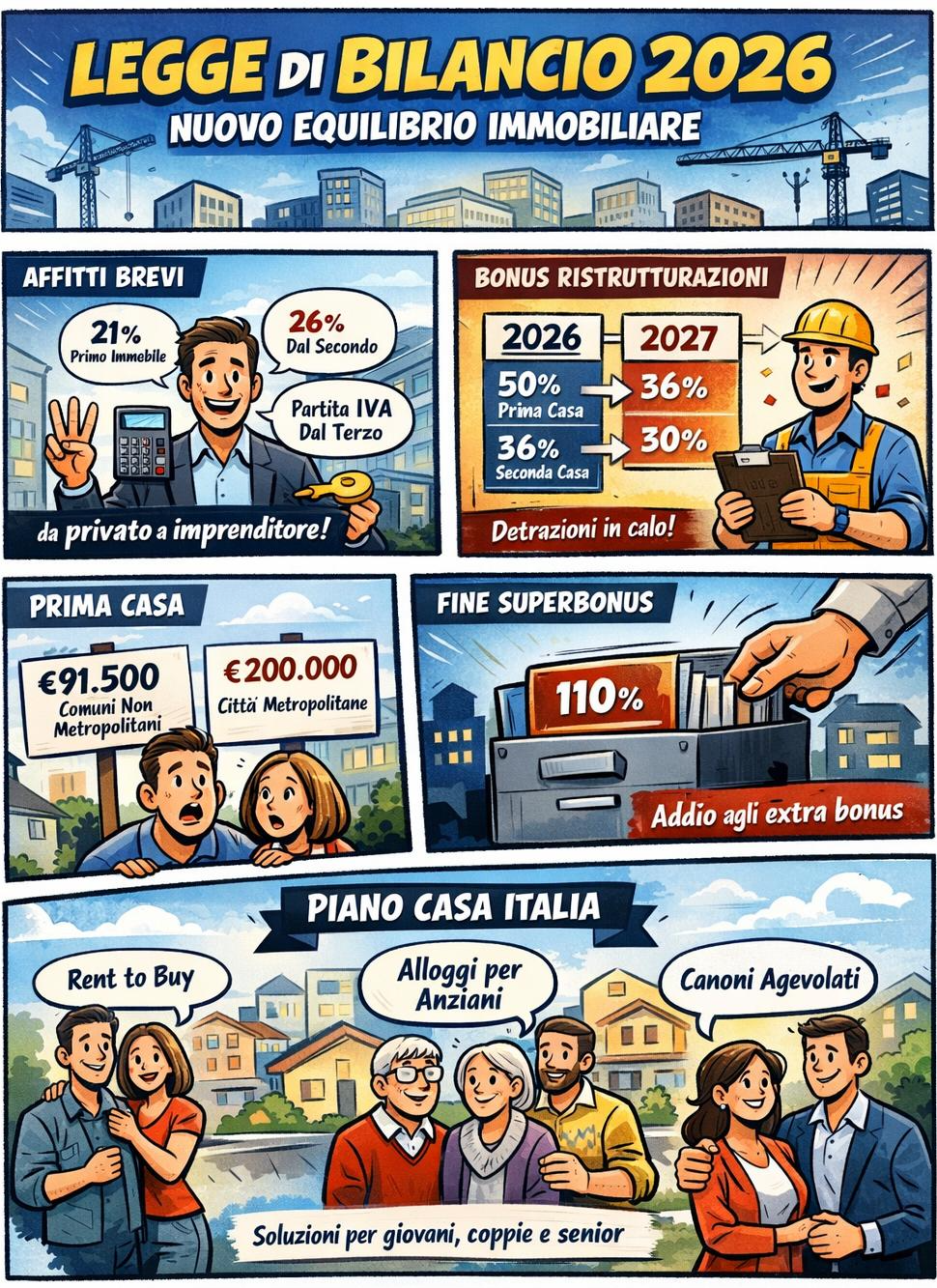
This article presents the 2026 Budget Law as a move towards a more stable framework for Italian property taxation, housing policy and incentives. It is an archive overview, not a complete statement of the rules applicable to an individual transaction.
For short-term lets, it discusses a 21% substitute-tax rate for one selected property, 26% for the second and treatment as a business from the third, with VAT registration requirements. These provisions must be read with the statutory definitions and the owner's actual activity.
The illustration shows increasing tax exposure as the number of short-let properties rises, distinguishing private letting from business activity.
For 2026 renovation incentives, the article describes 50% relief for qualifying main-home works and 36% for other eligible works, with a €96,000 ceiling per unit and provisions for common areas. It also discusses lower rates scheduled for 2027. Eligibility depends on the incentive, taxpayer, ownership and use of the property.
The comparison between 2026 and 2027 illustrates the scheduled rate reduction and the importance of checking timing before planning works.
The article also discusses funding for tenants in involuntary arrears and higher ISEE exclusions for the value of a main home, with distinctions between metropolitan and other municipalities and adjustments for larger households.
The illustration compares metropolitan and other municipalities to show the geographical distinction described in the budget measures.
The article places these measures alongside Piano Casa Italia, intended to increase residential and social housing through affordable rents, rent-to-buy arrangements and flexible options for younger people, families and older residents, including property exchanges and later disposals.
It describes the ending of the exceptional 110% Superbonus period, with limited earthquake-area exceptions relating to 2009 and 2016, and a shift towards more selective measures. The practical lesson is to check the applicable rules and plan over the medium to long term rather than assume an archived incentive remains available.