
This archive article examines a major proposed change to Italian succession and gift rules.
The Simplification Bill, linked to the budget process, proposed changes to forced heirs' protection where the deceased had made gifts during their lifetime.
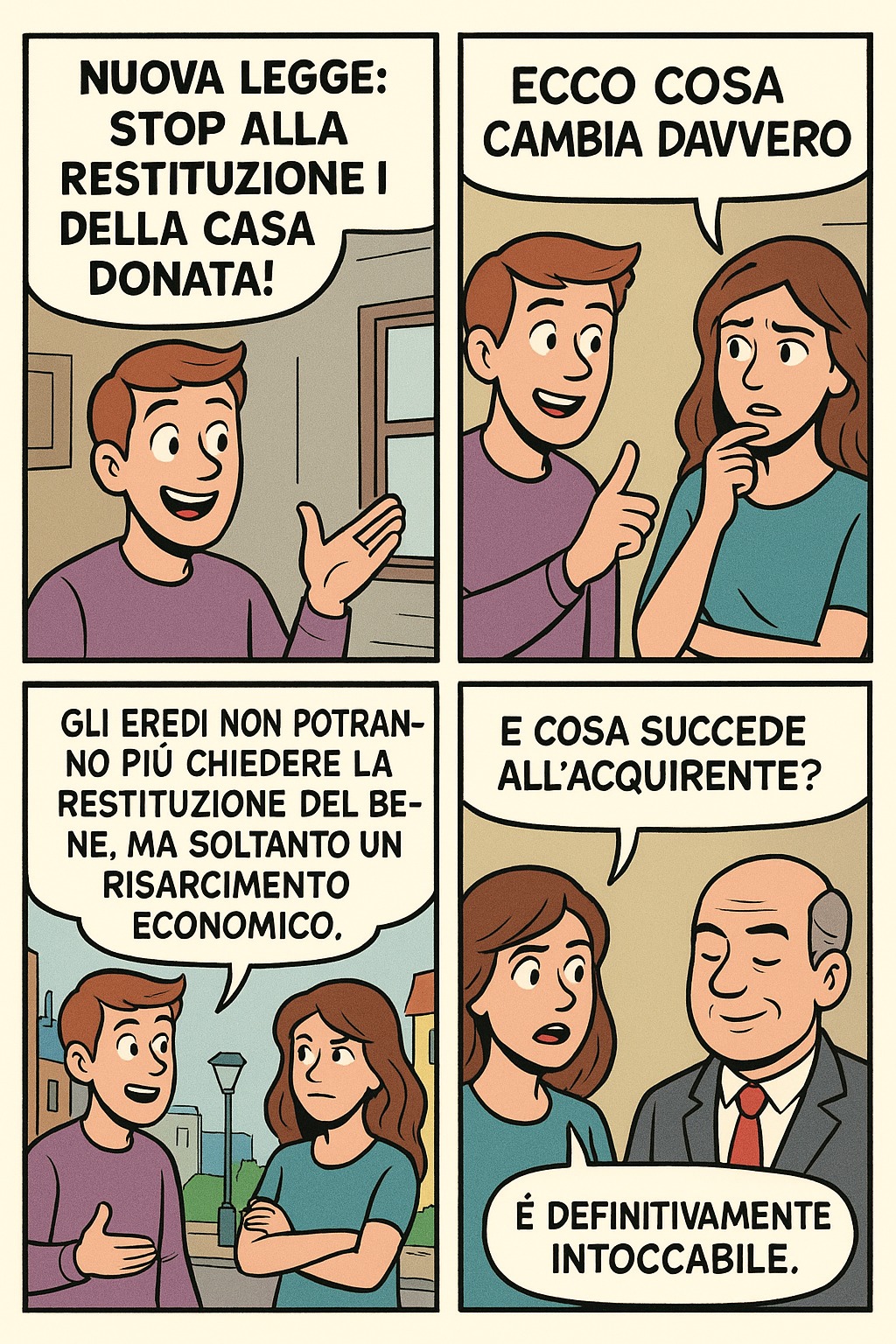
The article's central point was that
recovery of a donated property from a subsequent purchaser would be restricted, even where the original gift infringed a reserved inheritance share.
The protection would instead take the form of a monetary claim against the gift recipient.
The aim was to reduce the uncertainty that had discouraged purchases of donated properties.
Why the reform was proposed
The stated objective was to reduce longstanding uncertainty surrounding property acquired by gift.
Buyers, lenders and notaries had been concerned that heirs might, even years later:
- bring an action to reduce an excessive gift,
- challenge the gift,
- seek restitution of the property,
- and affect a subsequent good-faith purchaser.
The former mechanism under article 563 of the Civil Code strongly protected forced heirs but could obstruct transactions, leading to:
- specialist donation-risk insurance,
- complex arrangements such as mutual rescission of the gift,
- longer timescales and higher conveyancing costs.
The article describes a different approach under the Simplification Bill.
From recovery of the asset to financial protection
The proposed balance shifted protection from the asset to a monetary claim.
Before the reform
Forced heirs, including a spouse, descendants or qualifying ascendants, previously:
- could seek return of the donated asset,
- could proceed against the gift recipient and, under the former framework, against a subsequent purchaser;
- and benefited from a right to follow the asseteven after a transfer to a third party.
After the reform
The article describes the changes in article 44 as follows:
- restitution from a qualifying third-party purchaser would no longer be available for the donated property;
- the article describes a monetary claim against the gift recipient;
- a qualifying subsequent purchaser would be protected, subject to the rules governing registration of the purchase and reduction action.
The article explains that registration could stabilise the purchaser’s position, separating the acquired property from later claims under the reformed framework. The final legislation and transitional rules must be checked.
The exception involving a gift by an insolvent recipient
The article identifies an exception: where a third party receives a gift from an insolvent original recipient, a claim may also affect that later recipient, within the statutory conditions.
The article's wider claim that all other transfers are unconditionally safe is an oversimplification; the applicable law, registration and transitional provisions must be checked.
Potential effects on the market
For the property sector, the change was presented as potentially significant.
Homes acquired by gift could become:
- more straightforward to transfer,
- easier to sell,
- easier to finance,
- and more attractive to buyers and investors.
The reform sought to improve the marketability of donated property, removing a source of transactional uncertainty.
The heirs' protection and recovery risk
The article also highlights a concern raised by legal commentators:
monetary protection can be less effective in practice than recovery of a valuable asset.
An heir may have to rely on a claim against the gift recipient.
What happens if that person:
- has no assets,
- has substantial debts,
- cannot be located or is insolvent?
The practical risk is that
the heir's claim becomes unrecoverable, leaving no effective compensation.
Under the former framework, the property could provide a recoverable asset even much later, within the applicable conditions.
Simplification with important trade-offs
The new approach aimed at:
Helping sales and mortgage lending
Greater certainty for transactions
Reducing obstacles affecting donated homes
The article contrasts those market benefits with the risk that an heir's recovery depends on the recipient's financial position.
It therefore describes the reform as:
- modern in economic terms,
- bold in seeking to replace an inefficient mechanism,
- but potentially risky for relatives whose reserved shares may be harder to recover in practice. The reform's final text and transitional rules must be considered, rather than relying on this account of the bill.